Pelvic Floor for Runners: How to Stop Leaking on Long Runs
Based on Cochrane systematic reviews, peer-reviewed sports medicine research, and the 2019 UK Return to Running guidelines. See our editorial standards.
Quick Answer
Up to 41% of female runners experience urinary leakage during running. Each foot strike creates impact forces 2–3 times your body weight — the pelvic floor must contract fast enough to resist this pressure. A targeted 6-week program combining pelvic floor strengthening, the Knack technique, and form adjustments resolves leakage in most runners.
Why Do Runners Leak?
Urinary leakage during running — clinically called stress urinary incontinence (SUI) — is fundamentally a biomechanical problem. To understand why it happens, you need to understand what running actually does to your body with every single step.
Each time your foot strikes the ground during running, it generates a ground reaction force of approximately 2–3 times your body weight. For a 65 kg runner, that is 130–195 kg of force transmitted upward through the skeleton with every footstrike. This impact wave travels up through the tibia, femur, and pelvis, ultimately reaching the pelvic floor and the organs it supports.
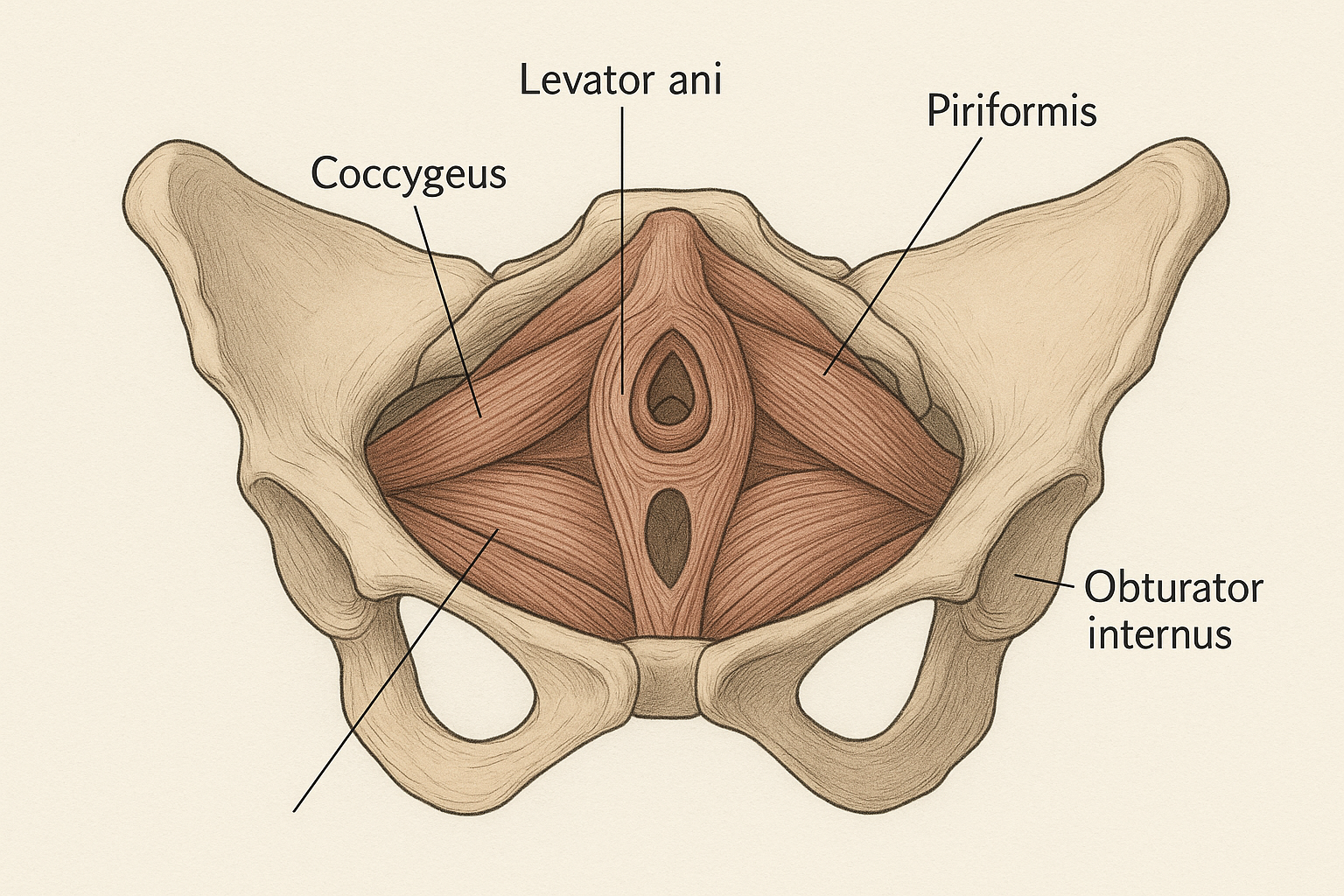
The pelvic floor's job is to act like a rapidly tensioning trampoline — it must pre-contract before impact to create sufficient counter-pressure to keep the urethra closed against the intra-abdominal pressure spike. In a well-trained pelvic floor, this happens automatically and almost instantaneously as a neuromuscular reflex. When the pelvic floor is weak, fatigued, or poorly coordinated, the reflex is too slow or too weak to close the urethra in time — and leakage results.
Who is most at risk? Research by Bø and Borgen found that 41% of elite female runners reported urinary incontinence during sport [1]. More broadly, studies estimate that 30–41% of female runners experience leakage, with prevalence highest in:
- Postpartum women — childbirth stretches and may tear the levator ani muscle and pudendal nerve, impairing both strength and reflex speed
- Perimenopausal and postmenopausal women — declining estrogen reduces tissue tone and collagen quality throughout the pelvic floor
- High-mileage runners — cumulative fatigue of the pelvic floor over long runs causes the protective reflex to degrade as distance increases
- Runners with poor form — over-striding with a heavy heel strike amplifies the vertical impact wave
Importantly, leakage is not exclusive to these groups. Nulliparous (never pregnant) women who run high mileage also experience SUI — evidence that the loading demands of running are themselves sufficient to overwhelm a pelvic floor that is not trained to handle them.
Is It Normal?
This question is worth addressing directly because the answer is frequently misunderstood in popular culture and even among runners themselves.
Leaking while running is common. It is not normal. "Common" describes prevalence — how frequently something occurs. "Normal" describes whether it is an expected, unavoidable outcome of the activity. Urinary leakage during running is neither expected nor unavoidable with appropriate pelvic floor training.
The cultural normalization of leakage among female athletes — the jokes about trampolining, the resigned acceptance — has a real cost. Women who accept leakage as "just part of running" are less likely to seek evaluation, less likely to receive treatment, and in some cases more likely to reduce or stop running entirely to avoid embarrassment. Stopping running is rarely the right answer.
The good news is clear: the vast majority of runners with stress incontinence see significant improvement or complete resolution within 6–8 weeks of a targeted program. You do not have to choose between running and a dry workout. For foundational technique guidance, start with our guide on how to do kegel exercises correctly.
The Knack Technique — Your First Line of Defense
The Knack is a deceptively simple technique that can produce dramatic, immediate results — and it requires no equipment, no gym membership, and almost no learning curve once you understand the concept.
What is the Knack? The Knack is a deliberate pelvic floor pre-contraction performed immediately before and during any activity that increases intra-abdominal pressure — in the context of running, that means contracting the pelvic floor just before each foot strikes the ground. By manually creating the reflex that should happen automatically, you close the urethra before the pressure spike arrives, preventing leakage.
The evidence for the Knack is striking. A landmark 1998 study by Miller et al. in the American Journal of Obstetrics and Gynecology demonstrated that teaching women to perform a voluntary pelvic floor pre-contraction before coughing produced a 73% immediate reduction in urine leakage, even in women who had not done any pelvic floor strengthening exercises [2]. The effect was rapid and required no equipment — just a learned motor pattern.
The challenge with the Knack during running is timing and automaticity — consciously thinking about contracting the pelvic floor before every footstrike at 170 steps per minute is not sustainable during a 10 km run. The goal, therefore, is to train the Knack into a reflex through progressive practice:
- Learn the contraction while standing still: Practice contracting your pelvic floor sharply (a quick, firm squeeze-and-lift) in response to a cue — snap your fingers, tap your knee, or use a metronome app set to 60 bpm. The contraction should be fast — not a slow hold, but a quick, sharp engagement lasting about half a second.
- Practice while walking: Contract the pelvic floor for a single step every 4–5 steps. Gradually increase frequency as the pattern becomes automatic. Walking practice is critical because it is the same gait pattern as running, just slower.
- Transition to slow jogging: Begin with 30-second jogging intervals at a pace slow enough to focus on form. Contract the pelvic floor in anticipation of each stride. You will not be perfectly in sync initially — that is fine.
- Increase pace and duration gradually: As the reflex becomes more automatic, you can increase pace. For most women, the Knack becomes largely automatic within 4–6 weeks of daily practice.
The Knack is your fastest-acting tool against running-associated leakage. Start practicing it today, even before you have built pelvic floor strength, because the motor learning alone produces measurable benefits.
Running Form Adjustments That Reduce Pelvic Floor Load
While strengthening the pelvic floor is the primary long-term solution, modifying your running mechanics can reduce the demand placed on the pelvic floor — making it easier for a recovering or undertrained pelvic floor to cope with the load. These three adjustments have the best evidence and are the easiest to implement without professional gait analysis.
1. Shorten Your Stride Length
Over-striding — landing with the foot well ahead of the body's center of mass — dramatically amplifies the vertical impact wave at ground contact. Research shows that reducing stride length by approximately 10% decreases impact loading rate by up to 20%, which is a substantial reduction in the force the pelvic floor must resist with each step. To shorten your stride: focus on landing with your foot closer to directly beneath your hip, not reaching forward. Your cadence will increase slightly as a natural consequence. You should feel lighter on your feet, not like you are shuffling.
2. Increase Your Cadence to 170–180 Steps per Minute
Cadence (steps per minute) and stride length are inversely related at the same running speed. A higher cadence means shorter strides, which means less vertical oscillation (bouncing) per step. Most recreational runners run at 155–165 steps per minute; increasing to 170–180 spm has been shown to reduce ground impact forces and improve running economy simultaneously. Use a free metronome app or a running playlist timed to the right bpm. You can increase cadence by 5% per week without disrupting your form significantly.
3. Adopt a Slight Forward Trunk Lean
A slight forward lean from the ankles (not a hunch from the waist) shifts your center of gravity forward, encourages a midfoot strike pattern, and reduces the heel-strike impact spike that sends the highest vertical loads through the pelvis. Combined with a shortened stride, this lean produces a running pattern that is both more efficient and significantly less impactful on the pelvic floor. Think of leaning into a gentle wind — the entire body inclines together, rather than just bending the torso forward.
Form change tip
Do not try to change all three aspects of running form simultaneously. Pick one — cadence is usually the easiest to start with — and spend 2 weeks adapting before adding another change. Sudden large changes to running mechanics can increase injury risk while your body adapts.
The 6-Week Pelvic Floor Training Program for Runners
This program is designed specifically for runners experiencing leakage. It progresses systematically from foundational strength to functional loading — ensuring the pelvic floor is genuinely prepared for the demands of running before those demands are reapplied. Use the PelvicFit timer to track your sets.
| Phase | Exercises | Protocol | Running Activity |
|---|---|---|---|
| Weeks 1–2 Foundation | Slow kegels lying down; quick contractions (flicks) lying down; diaphragmatic breathing | 3 sets × 10 reps slow (5 sec hold); 10 quick flicks; daily | Walking only — practice Knack technique every 4–5 steps |
| Weeks 3–4 Loading | Kegels seated and standing; single-leg balance with pelvic contraction; glute bridges with pelvic hold | 3 sets × 12 reps (6–8 sec hold) seated + standing; 10 single-leg stands × 30 sec; daily | Power-walk intervals (brisk walking); continue Knack practice; no running yet if leakage present |
| Week 5 Transition | Add single-leg squats with pelvic contraction; step-ups with hold; Knack timed to walking cadence | 3 sets × 10 reps per exercise; Knack practice at walking cadence 5 min daily | Introduce low-impact jogging: 30-sec jog, 90-sec walk × 8 intervals; monitor for leakage |
| Week 6 Running | Jump squats (pelvic contraction on landing); running-specific drills; Knack at jogging cadence | 2 sets × 10 jump squats; 5 min Knack jogging drill; 3 days/week maintenance kegels | Progressive run intervals: build from 2-min to 5-min continuous running with Knack reflex |
Progress at your own rate. If leakage occurs at any phase, reduce running intensity and spend an additional week on the previous phase before progressing. No leakage at any step is the progression criterion.
Exercises Beyond Kegels — Functional Pelvic Floor for Runners
Standard kegel exercises build pelvic floor endurance and baseline strength. But running demands more than endurance — it requires fast-twitch pelvic floor activation, single-leg loading, and the ability to maintain closure through impact. These three exercises bridge the gap between the kegel mat and the running trail.
1. Single-Leg Squat with Pelvic Floor Contraction — The Most Functional Exercise for Runners
Running is essentially a series of single-leg loading events. The single-leg squat replicates this demand while adding the requirement to hold a pelvic floor contraction under load.
How to perform: Stand on one leg with a slight forward lean. Contract your pelvic floor before beginning. Slowly lower into a single-leg squat to about 45 degrees, maintaining the pelvic contraction throughout. Pause at the bottom for 2 seconds, then rise. Do 3 sets of 8–10 reps per leg. Common mistakes: letting the knee cave inward (this reduces gluteal activation which supports the pelvic floor), or losing the pelvic contraction at the bottom of the movement.
2. Jump Squat Progression — Training Fast-Twitch Pelvic Floor Fibers
The pelvic floor must activate in milliseconds during running. Slow exercises do not train this explosive quality. Jump squats specifically target the fast-twitch (Type II) pelvic floor muscle fibers that fire during high-impact activity.
How to perform: Stand with feet shoulder-width apart. Perform a shallow squat, then jump into the air with a moderate height. Land softly with a slight knee bend, contracting the pelvic floor at the moment of landing. The pelvic floor contraction should be quick and sharp — like the Knack — not a sustained squeeze. Do 2–3 sets of 8–10 reps. Begin with a box jump (stepping down) to reduce impact if running-associated leakage is still present.
3. Step-Up with Pelvic Hold — Mimicking Running Gait
The step-up replicates the single-leg loading phase of running at a controlled, low-impact pace. It is ideal for the early transition phase when you are building toward jogging.
How to perform: Stand in front of a step or stair (15–20 cm height). Contract your pelvic floor. Step up with your right foot, bringing your left foot up to meet it. Step back down leading with the right foot. Maintain the pelvic contraction throughout — do not release between reps. Complete 3 sets of 12 reps per leg. Increase step height as strength improves.
Postpartum Return to Running — The 12-Week Minimum
Postpartum return to running is one of the most common pelvic floor questions — and one of the most frequently mishandled in mainstream fitness culture, where "bouncing back" is sometimes encouraged within weeks of delivery.
The 2019 UK Return to Running guidelines, developed by Groom, Donnelly, and Brockwell in collaboration with pelvic health physiotherapists, provide the clearest evidence-based framework for postpartum runners. Their central recommendation: wait a minimum of 12 weeks postpartum before attempting running, regardless of how you feel or how quickly you want to return. This waiting period allows for:
- Initial healing of perineal and pelvic floor tissue damage from delivery
- Hormonal stabilization (particularly relaxin levels, which remain elevated postpartum and continue to affect ligament laxity)
- Sufficient pelvic floor neuromuscular recovery to handle impact loading
Beyond waiting 12 weeks, the guidelines specify functional readiness criteria that must be metbefore running is attempted — not just a time-based clearance:
- 30-minute brisk walk without pelvic heaviness, pain, or leakage: If you cannot walk for 30 minutes comfortably, the pelvic floor is not ready for the significantly higher loads of running.
- Trampoline jogging without symptoms: Jogging on a small trampoline (or doing gentle bouncing) is lower-impact than road running. If symptoms occur here, the pelvic floor needs more time.
- 10 single-leg hops without leakage or pelvic pain: This tests the fast-twitch pelvic floor capacity that running demands, in an isolated, controlled way.
These criteria matter because the 12-week mark is a minimum, not a guarantee of readiness. Some women are ready at 12 weeks; others need 16–20 weeks, particularly after complex deliveries, significant perineal trauma, or caesarean section (which requires abdominal healing in addition to pelvic floor recovery). A pelvic floor physiotherapy assessment at 6–8 weeks postpartum is the gold standard recommendation. For a full postpartum recovery program, see our postpartum pelvic recovery guide.
Bladder Management for Running
Pelvic floor strengthening and the Knack address the muscular side of running-associated leakage. But bladder management — how you prepare your bladder before and during running — can make a meaningful difference in the short term while your training takes effect.
Timing Your Pre-Run Void
Void (urinate) once, 20–30 minutes before your run begins. Do not urinate immediately before the run if you can avoid it — this trains the bladder to empty at lower volumes and can worsen urgency and frequency over time. The goal is to begin running with a comfortably half-full bladder, not an urgently full one or a completely empty one. A completely empty bladder offers no cushioning for the pelvic floor and does not change incontinence mechanics.
Resist the Urge to Double-Void
Many women with leakage anxiety develop a habit of voiding multiple times before a run — "just in case." This "just in case" voiding pattern trains the bladder to signal fullness at smaller volumes, progressively worsening urgency and frequency over weeks and months. Resist the urge to void again if you have urinated within the last 20–30 minutes and do not have a pressing need.
Caffeine Timing
Caffeine is a diuretic and bladder irritant. It increases urine production and lowers the threshold at which the bladder signals urgency. For runners who use caffeine for performance, consuming it 60–90 minutes before a run (to allow some metabolism) and staying well-hydrated around it can reduce its impact on leakage. If morning runs immediately follow coffee, try shifting coffee to post-run while you are in active rehabilitation.
Hydration Strategy
Under-hydrating in an attempt to reduce leakage is counterproductive. Concentrated urine irritates the bladder lining, increasing urgency. Drink enough fluid to keep urine pale yellow, and aim for consistent fluid intake throughout the day rather than large volumes immediately before running. For runs under 60 minutes, pre-run hydration is sufficient; for longer runs, regular small sips during the run are preferable to large volumes at once.
For comprehensive guidance on bladder control exercises and strategies, see our guide on kegel exercises for bladder control.
When to See a Pelvic Floor Physiotherapist
Self-directed training using this guide is appropriate and effective for many runners. However, professional assessment is strongly recommended in the following circumstances:
- Persistent leakage after 6–8 weeks of consistent training: If symptoms have not improved meaningfully despite following a structured program, there may be underlying factors — including hypertonic (too-tight) pelvic floor, levator ani avulsion, or other anatomical changes — that require hands-on assessment and individualized treatment.
- Symptoms of prolapse alongside leakage: A sensation of vaginal heaviness, pressure, or bulging — particularly symptoms that worsen with running — suggests possible prolapse that should be evaluated before high-impact exercise is continued.
- Pelvic pain during or after running: Pain in the pelvis, perineum, hips, or lower back that is associated with running and pelvic floor activation requires clinical assessment to rule out muscle injury, nerve entrapment, or musculoskeletal causes.
- Postpartum runners planning to return to training: The pelvic floor physiotherapy assessment at 6–8 weeks postpartum that the 2019 guidelines recommend is genuinely the best investment a postpartum runner can make — it identifies dysfunction early, before it becomes a training obstacle.
- Leakage occurring at low running intensities or after very short distances: Leakage at the beginning of a run, or during slow jogging, suggests more significant dysfunction than leakage that only occurs late in long or fast runs.
A pelvic floor physiotherapist can perform internal assessment to evaluate muscle strength, coordination, and any structural changes, and can provide biofeedback-guided training to confirm you are recruiting the correct muscles. This level of assessment is not replicable with at-home programs alone.
Frequently Asked Questions
Why do I leak urine when I run?
Urine leakage during running (stress urinary incontinence) happens because each foot strike generates a ground reaction force 2–3 times your body weight, sending an impact wave upward through the body. When the pelvic floor cannot generate enough force quickly enough to close the urethra against this pressure spike, leakage occurs. It is more common after childbirth (which stretches the pelvic floor), during menopause (estrogen loss reduces tissue tone), and in runners with a weak or poorly coordinated pelvic floor regardless of birth history. The solution is training the pelvic floor specifically for the speed and magnitude of force generation that running demands — which is different from and more demanding than standard kegel exercises.
Is it normal to pee a little when running?
It is common — affecting 30–41% of female runners — but not normal in the sense of being unavoidable or something you should just accept. Urinary leakage during running is a sign that the pelvic floor needs training or that technique adjustments are needed. With appropriate pelvic floor rehabilitation, the majority of runners are able to return to training without leakage within 6–12 weeks. Accepting leakage as inevitable often means missing treatable dysfunction that worsens over time if left unaddressed.
How do I stop leaking when I run?
The most effective strategies, used in combination, are: (1) the Knack technique — contracting the pelvic floor just before each footstrike, trained into a reflex over 4–6 weeks; (2) pelvic floor strengthening with the 6-week program above, progressing from lying kegels to functional exercises like single-leg squats and jump squats; (3) running form adjustments — shortening stride length and increasing cadence reduces impact force on the pelvic floor by up to 20%; and (4) bladder management — starting runs with a half-full bladder and avoiding double-voiding. Combined, these approaches resolve leakage in most runners within 6–8 weeks.
When can I return to running after giving birth?
The 2019 UK Return to Running guidelines (Groom, Donnelly, Brockwell) recommend waiting at least 12 weeks postpartum before attempting running, with a pelvic floor physiotherapy assessment beforehand. Before returning, you should be able to walk 30 minutes without pelvic heaviness, jog on a trampoline without leakage, and perform 10 single-leg hops without symptoms. These functional criteria ensure the pelvic floor can handle the high-impact loads of running before they are applied — the 12 weeks is a minimum, not a guaranteed clearance.
Does running make pelvic floor problems worse?
Running on a weak or recovering pelvic floor — particularly if significant leakage or prolapse symptoms are present — can worsen dysfunction if the muscles cannot support the repeated impact loads over time. This is why continuing to run through significant leakage without rehabilitation is not advisable. However, running on a well-conditioned pelvic floor is safe and beneficial. The solution for most women is not to stop running permanently, but to temporarily reduce running load, build pelvic floor capacity through the program above, then progressively return to full training. Running is worth fighting for.
References
- Bø K, Borgen JS. Prevalence of stress and urge urinary incontinence in elite athletes and controls. Med Sci Sports Exerc. 2001;33(11):1797-1802.
- Miller JM, Ashton-Miller JA, DeLancey JOL. A pelvic muscle precontraction can reduce cough-related urine loss in selected women with mild SUI. J Am Geriatr Soc. 1998;46(7):870-874.
- Groom T, Donnelly G, Brockwell E. Returning to running postnatal — guidelines for medical, health and fitness professionals managing this population. Absolute Physio / Groom & Associates. 2019. Available at: returningtorunningpostnatal.com
Key Takeaways
- 1. Up to 41% of female runners experience urinary leakage, but it is not inevitable — the pelvic floor can be trained to handle the demands of running.
- 2. The Knack technique — a pelvic floor pre-contraction before each footstrike — produces 73% immediate reduction in leakage even before strength training takes effect.
- 3. Shortening stride length and increasing cadence to 170–180 spm reduces pelvic floor impact load by up to 20% without reducing running performance.
- 4. The 6-week program progresses from lying kegels to functional running-specific exercises — do not skip phases, as each builds the capacity for the next.
- 5. Postpartum runners should wait a minimum of 12 weeks and meet functional readiness criteria (30-min walk, trampoline jog, 10 single-leg hops without symptoms) before returning to running.
PelvicFit 6-Week Runner's Program
Designed by physiotherapists for runners experiencing pelvic floor dysfunction. Start free — no account needed. Includes guided timers, Knack drill cues, and progressive loading.
Start the free programAbout the Authors
PelvicFit Editorial Team
The PelvicFit editorial team produces evidence-based content on pelvic floor health, drawing on peer-reviewed research, clinical guidelines, and the expertise of our medical advisory board.
Sarah Mitchell, DPT — Reviewer, Physical Therapist specializing in pelvic floor dysfunction
Sarah holds a Doctor of Physical Therapy degree and has 12 years of clinical experience treating pelvic floor disorders including stress incontinence, prolapse, and postpartum recovery in active and athletic populations. She has treated over 800 patients and works regularly with female endurance athletes.